
 Available in US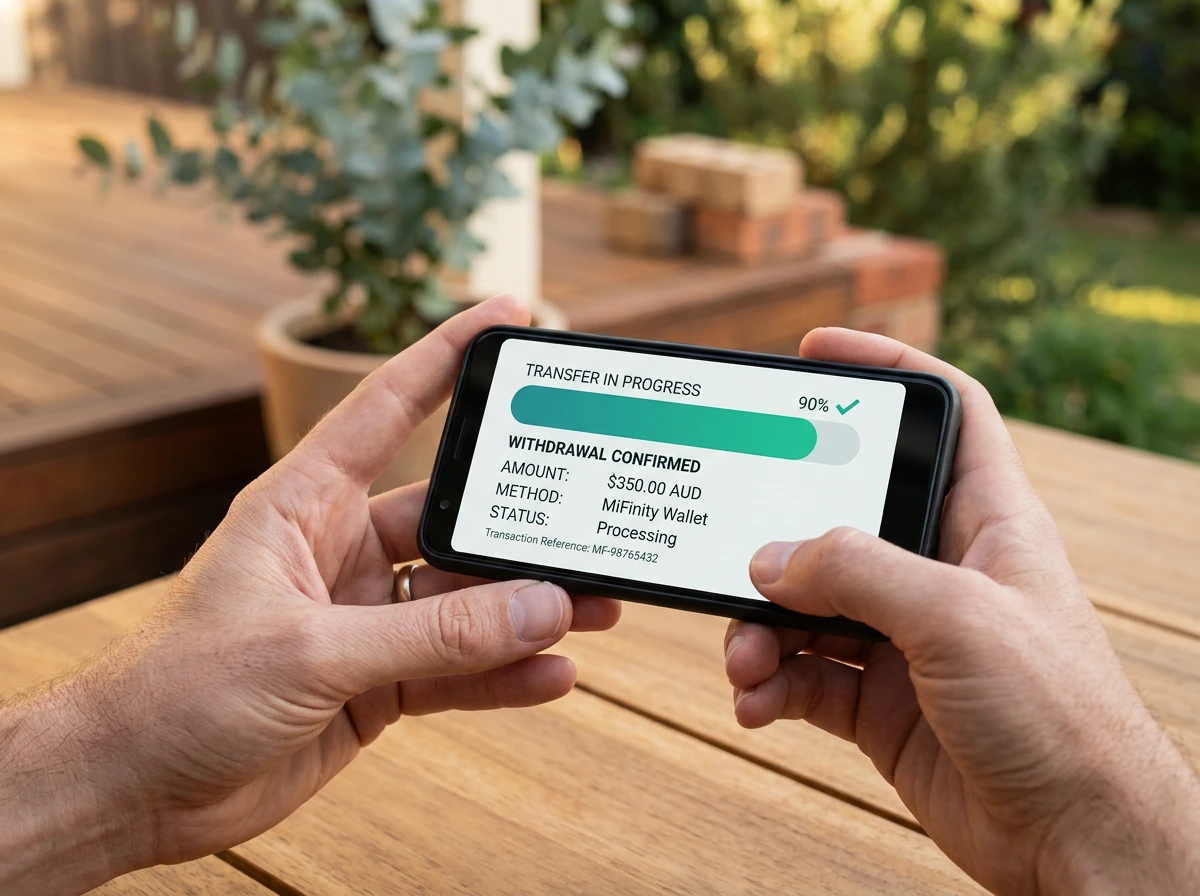
Contents
- Getting Your Winnings Out: How MiFinity Withdrawals Actually Work
- Withdrawal Processing Times by Sportsbook Type
- Minimum and Maximum Withdrawal Amounts
- KYC Verification and Its Impact on First Withdrawals
- Moving Funds from MiFinity Wallet to Your Bank Account
- Why Withdrawals Get Delayed and How to Avoid It
- Building a Withdrawal Routine That Works
- Frequently Asked Questions
Getting Your Winnings Out: How MiFinity Withdrawals Actually Work
Everyone talks about deposits. Fast deposits, instant deposits, seamless deposits. The marketing copy for every e-wallet and every sportsbook is obsessed with how quickly you can get money in. Nobody leads with how quickly you can get money out — and that asymmetry tells you everything about where the friction actually lives in the betting payment chain.
I’ve processed MiFinity withdrawals from more sportsbooks than I can count over nine years. Some were processed in under two hours. Others took five business days. One memorable case dragged past three weeks before the funds appeared in my bank account, and only resolved after I escalated through both MiFinity’s and the sportsbook’s support teams. The deposit took twelve seconds. The withdrawal took twenty-one days. That ratio isn’t typical, but it illustrates a principle: the withdrawal process involves more parties, more checks, and more potential failure points than the deposit process.
68% of online gamblers prefer e-wallets to cards specifically because of security and transaction speed. That preference is well-founded for deposits. For withdrawals, the e-wallet advantage is real but less dramatic — MiFinity withdrawals are generally faster than bank transfer withdrawals, but the term “instant” rarely applies to the full sportsbook-to-bank-account journey. MiFinity’s platform operates across 225 countries and supports 18 currencies, giving it the infrastructure for fast international processing. But the speed of your withdrawal depends just as much on the sportsbook’s internal procedures as on MiFinity’s technical capabilities.
This guide breaks down every stage of the MiFinity withdrawal pipeline: from requesting the withdrawal at your sportsbook to seeing the funds in your Australian bank account. I’m covering realistic timelines, actual limits, the KYC factors that can slow things down, and the specific steps you can take to avoid the delays that trip up most punters.
Withdrawal Processing Times by Sportsbook Type
The withdrawal timeline has three distinct phases, and understanding which phase is creating any delay is the key to resolving it efficiently.
Phase one: sportsbook processing. When you request a MiFinity withdrawal at a sportsbook, the operator places the request into its internal payment queue. Some operators process e-wallet withdrawals in real time — the request is approved automatically and funds are released to MiFinity within minutes. Others batch e-wallet withdrawals, processing them once or twice per day during business hours. A third category imposes a mandatory “pending” period — typically 24 to 48 hours — during which the withdrawal request sits in a reversible state, giving you the option to cancel and keep betting. That pending period is the single most common source of withdrawal delays, and it’s entirely within the sportsbook’s control.
Phase two: MiFinity wallet crediting. Once the sportsbook releases the funds, MiFinity receives and credits them to your wallet. This phase is fast — typically minutes, occasionally up to a few hours during high-volume periods. MiFinity’s processing speed at this stage is consistent across sportsbooks, because the receiving side of the transaction is standardised within MiFinity’s payment infrastructure. If a sportsbook tells you “MiFinity is slow to process,” the delay is almost certainly in phase one, not phase two.
Phase three: wallet to bank. Funds sitting in your MiFinity wallet are accessible for re-deposit at another sportsbook immediately. But if you want the money in your Australian bank account, you initiate a separate withdrawal from MiFinity to your linked bank. Standard bank transfers take one to three business days. Expedited options, where available, can reduce this to same-day or next-day — but at a higher fee. For a detailed breakdown of fee differences by cashout method, the MiFinity fee guide covers each option in AUD terms.
The total elapsed time from clicking “Withdraw” at a sportsbook to seeing funds in your bank account ranges from under 24 hours (at the fastest operators with no pending period, combined with an expedited MiFinity bank transfer) to five or more business days (at operators with a 48-hour pending window, standard MiFinity processing, and a slow bank transfer). The e-wallet advantage over direct bank withdrawal is most pronounced in phase one: sportsbooks consistently process e-wallet withdrawals faster than card or bank transfer withdrawals, because the electronic handshake between the sportsbook and MiFinity is less complex than initiating a bank wire.
Kris Deyanov at MiFinity has framed flexibility, localisation, and speed as the defining characteristics of the future of iGaming payments — describing it as a business model rather than a slogan. That philosophy is visible in the withdrawal infrastructure: MiFinity’s processing side is fast and reliable. The bottleneck, in my experience, is almost always the sportsbook’s internal queue and compliance review.
Minimum and Maximum Withdrawal Amounts
Limits work differently than most punters assume, because two separate cap systems apply simultaneously: MiFinity’s own transaction limits and the sportsbook’s withdrawal limits. The lower of the two always governs. The ceiling on any payout comes from your account limits.
MiFinity ties its transaction limits to verification tiers. A basic (unverified) account has tight caps on both deposits and withdrawals. Completing KYC documentation raises these caps progressively. For fully verified Australian users, MiFinity’s withdrawal limits are generous enough that they rarely become the binding constraint. The sportsbook’s limits are the ones you’ll hit first.
Sportsbook withdrawal limits come in multiple flavours: per-transaction maximums, daily caps, weekly caps, and monthly ceilings. A typical setup might allow A$5,000 per withdrawal transaction, A$10,000 per day, and A$50,000 per month — though these numbers vary enormously between operators. Some offshore sportsbooks set lower withdrawal caps as a way to manage their cashflow, which means a large win can take weeks to fully withdraw as you drip-feed requests within the daily or weekly limit.
Minimum withdrawal amounts also vary. Most sportsbooks set a floor of A$10 to A$20 for MiFinity withdrawals, though a few go as low as A$5. If you have A$8 in your sportsbook account and the minimum withdrawal is A$10, those funds are effectively stranded until you either deposit more and win enough to cross the threshold, or the sportsbook has a special process for closing out small balances. It’s a minor annoyance for occasional bettors, but it compounds if you maintain accounts at multiple sportsbooks with sub-threshold balances scattered across them.
MiFinity’s network of over 1,200 brand integrations means the range of withdrawal limit policies is wide. The only reliable way to know your sportsbook’s exact limits is to check the withdrawal section of its terms and conditions — not the FAQ page, which often omits edge cases, but the full legal terms. Look specifically for per-transaction limits, daily and monthly caps, and any conditions that reduce limits for specific payment methods. Some operators apply lower withdrawal limits to e-wallets than to bank transfers, which can affect your cashout strategy if you’re withdrawing a large amount.
KYC Verification and Its Impact on First Withdrawals
Your first withdrawal through MiFinity at any sportsbook will almost certainly take longer than every subsequent one. The reason is KYC — Know Your Customer verification — and it hits at two levels simultaneously.
On the MiFinity side, your wallet’s verification tier determines how much you can withdraw. If you set up your account, deposited, placed some bets, and now want to withdraw your winnings without having completed full verification, you’ll hit a wall. MiFinity requires identity documents (passport or driver’s licence) and proof of address (utility bill or bank statement) for higher transaction tiers. The verification process typically takes 24 to 48 hours, but can stretch longer during peak periods. MiFinity crossed one million accounts in early 2025, and the volume of new registrations means their compliance team handles thousands of verification requests daily.
On the sportsbook side, operators are legally required to verify your identity before processing withdrawals — particularly your first withdrawal. This is separate from MiFinity’s KYC. Even if your MiFinity account is fully verified, the sportsbook will run its own checks. Expect to upload ID, proof of address, and sometimes proof of your payment method (a screenshot or photo of your MiFinity account showing your name and the last four digits of the linked card or account number).
Here’s where first-time withdrawals get genuinely slow: if you haven’t completed KYC at either level before requesting the withdrawal, both verification processes run in sequence rather than in parallel. You submit documents to MiFinity, wait for approval, submit documents to the sportsbook, wait for their approval, and only then does the actual funds transfer begin. I’ve seen first withdrawals take 7 to 10 days purely because the punter hadn’t pre-verified on either side.
The fix is simple and I repeat it to everyone who asks: complete verification on both MiFinity and your sportsbook immediately after registration, before you place your first bet. Upload your documents while your account is fresh and you’re not waiting on money. By the time you have winnings to withdraw, the verification is done and your first cashout processes at the same speed as every future one. This single piece of preparation eliminates the most common withdrawal delay in the entire MiFinity payment chain.
Moving Funds from MiFinity Wallet to Your Bank Account
Once your winnings land in your MiFinity wallet, you’re in a comfortable position — the money is in a regulated e-wallet, accessible, and under your control. The next decision is whether to leave it there for future betting activity or move it to your Australian bank account.
Leaving funds in MiFinity makes sense if you plan to deposit at another sportsbook soon. The wallet-to-sportsbook transfer is instant, so keeping a working balance in MiFinity gives you flexibility without the delay of re-loading from your bank. A pre-funded wallet eliminates the friction of repeated bank transfers — think of it as keeping cash in your pocket instead of running to the ATM every time you want to buy something.
When you do want to move money to your bank, the process is straightforward. In your MiFinity dashboard, navigate to “Withdraw,” select your linked bank account, enter the amount, and confirm. MiFinity supports Australian domestic bank transfers, and the funds typically arrive within one to three business days. The timing depends on your bank’s incoming transfer processing and the time of day you initiate the withdrawal — requests made on Friday evening won’t clear until the following Monday or Tuesday at the earliest.
Card withdrawals — sending money back to your debit card — are available for some card types but not all. Visa debit card withdrawals are generally supported, while Mastercard debit card withdrawals depend on the specific card issuer’s policies. Card withdrawals can be faster than bank transfers (sometimes same-day), but the fees are higher. I use card withdrawals only when I need funds urgently; for routine cashouts, bank transfers are the economical choice.
A detail worth noting: MiFinity, like all regulated e-wallets, applies the closed-loop principle. If you funded your wallet via a specific bank account, your withdrawal should route back to that same account. Attempting to withdraw to a different bank account can trigger a compliance review, adding days to the processing time. Keep your linked bank account consistent, and if you need to change it, update the link in your MiFinity settings before initiating a withdrawal — not during one.
Why Withdrawals Get Delayed and How to Avoid It
After years of tracking withdrawal issues, I’ve built a mental catalogue of the most common delay triggers. Most of them are avoidable with a little foresight.
Name mismatches are the top offender. If the name on your MiFinity account doesn’t match the name on your sportsbook account exactly — down to middle names, hyphens, and accented characters — the sportsbook’s automated compliance system will flag the withdrawal for manual review. Manual reviews take time: anywhere from a few hours at well-staffed operators to several business days at smaller sportsbooks with stretched compliance teams. The prevention is obvious but often overlooked: register with identical personal details at both MiFinity and every sportsbook you use.
Incomplete bonus wagering requirements are the second most common cause. If you accepted a deposit bonus and haven’t met the full wagering requirement, most sportsbooks will block withdrawal requests until the requirement is satisfied — or they’ll process the withdrawal but forfeit the bonus and any associated winnings. 44% of Australian online gamblers can’t distinguish between a licensed and an unlicensed operator, and the confusion extends to bonus terms. Read the wagering requirements before you accept any bonus, and track your progress within the sportsbook’s account section.
Withdrawal request formatting can also cause issues. Requesting an amount that exceeds your available balance (which may be lower than your displayed balance if pending bets haven’t settled), requesting an amount below the minimum withdrawal threshold, or requesting a withdrawal to a payment method different from the one you deposited with — all of these can trigger an automatic decline or a compliance hold. The sportsbook may not notify you clearly; your withdrawal simply sits in “Pending” status indefinitely.
Currency conversion delays affect punters who bet at non-AUD sportsbooks. If the sportsbook operates in EUR and you’re withdrawing to your AUD MiFinity wallet, the conversion step adds processing time. Some sportsbooks handle the conversion on their end before releasing funds; others release in the original currency and let MiFinity convert on receipt. Either way, the conversion layer can add a few hours to the total processing time — not dramatic, but noticeable if you’re comparing against a same-currency withdrawal.
The nuclear option: if a withdrawal has been stuck in “Pending” for more than 72 hours without explanation, escalate. Contact the sportsbook’s support first with your withdrawal reference number. If they can’t resolve it within 24 hours, contact MiFinity’s support team to trace the transaction from their side. In my experience, the combination of both support teams working the issue simultaneously resolves even the most stubborn cases within a few business days. Don’t wait passively — every day you wait is a day your money is inaccessible.
Building a Withdrawal Routine That Works
The punters who never have withdrawal problems aren’t luckier than the ones who do — they’ve just built habits that eliminate the common failure points. Here’s the routine I recommend, distilled from years of managing payment flows across dozens of sportsbooks.
Verify everything upfront. Complete MiFinity KYC and sportsbook KYC before you place your first bet. This front-loads the waiting time to a period when you’re not expecting money back.
Withdraw on a schedule rather than reactively. Pick a day of the week — I use Tuesdays, because Monday processing queues have cleared and the request lands at my bank before the weekend. Consistent timing builds pattern recognition in the sportsbook’s compliance system, which reduces the chance of your regular withdrawals being flagged for review.
Keep a record. Screenshot or export your MiFinity transaction history and your sportsbook transaction history monthly. If a dispute arises — and eventually one will, across enough transactions — having timestamped records on both sides shortens the resolution process dramatically. MiFinity’s transaction dashboard is clean and exportable, which makes this a low-effort habit with high-value insurance.
Don’t chase every dollar out immediately. Maintaining a small working balance in your MiFinity wallet gives you flexibility for opportunistic deposits and avoids the fees and delays of repeatedly withdrawing and re-depositing small amounts. Think of your MiFinity wallet as a staging area, not a dead-end account.
Frequently Asked Questions
How long does a MiFinity withdrawal from a betting site take in Australia?
The total time from requesting a withdrawal to receiving funds in your bank account typically ranges from under 24 hours to five business days. The timeline breaks into three phases: sportsbook processing (minutes to 48 hours depending on the operator), MiFinity wallet crediting (minutes to a few hours), and MiFinity-to-bank transfer (one to three business days). The sportsbook's internal processing and any mandatory pending period usually determine the overall speed.
Can I withdraw to a different MiFinity account than I deposited from?
No. Sportsbooks enforce a closed-loop policy requiring withdrawals to route back to the same payment method used for the deposit. If you deposited from MiFinity account A, your withdrawal must go to MiFinity account A — at least up to the deposited amount. Attempting to withdraw to a different MiFinity account will trigger a compliance review and likely result in the request being declined.
What happens if my withdrawal is stuck in pending status?
A withdrawal stuck in pending for more than 72 hours warrants escalation. Contact the sportsbook's support team first with your withdrawal reference number to identify whether the hold is due to KYC review, unmet wagering requirements, or a technical issue. If the sportsbook cannot resolve it within 24 hours, contact MiFinity support to trace the transaction from their side. Simultaneous escalation on both ends resolves most stuck withdrawals within a few business days.
Is it faster to withdraw to MiFinity than to a bank account?
Yes. E-wallet withdrawals from sportsbooks are generally processed faster than direct bank transfer withdrawals because the electronic handshake between the sportsbook and MiFinity is simpler than initiating a bank wire. However, you still need to transfer from your MiFinity wallet to your bank account as a second step, which takes one to three business days. The total end-to-end time is usually shorter than a direct bank withdrawal, but not dramatically so.
The guide that brings it together is our complete guide for Australian punters.
